ThinkMedical
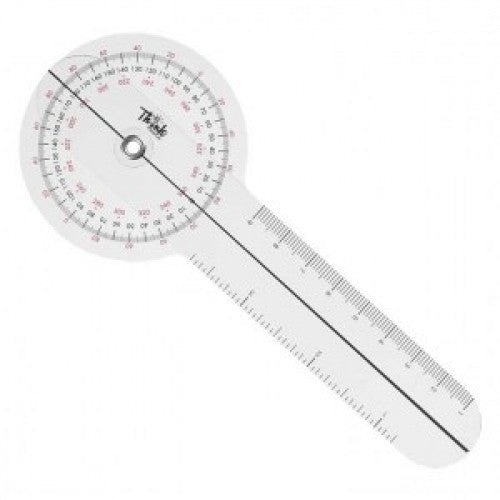
Ruler - Goniometer Protractor
Ruler - Goniometer Protractor
ea
SKU: SG-94544
Couldn't load pickup availability
Description
Description
Protractor Goniometer Ruler – Joint Range of Motion Measurement Tool
The Protractor Goniometer Ruler is a practical clinical measurement instrument designed to measure joint angles, range of motion (ROM), flexibility, and movement progression during physical assessment, rehabilitation, physiotherapy, and clinical education.
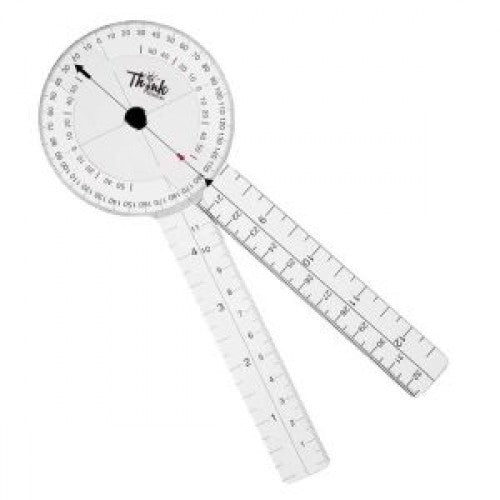
Featuring a 360-degree protractor scale with adjustable ruler arms, a goniometer allows healthcare professionals to accurately measure joint movement and document changes over time. It is commonly used by physiotherapists, occupational therapists, physicians, nurses, chiropractors, rehabilitation professionals, sports medicine practitioners, and healthcare students.
Ideal for physiotherapy clinics, rehabilitation centres, hospitals, orthopedic practices, sports medicine facilities, educational laboratories, and home-care environments.
Purpose of a Protractor Goniometer
A goniometer measures the angle created by a joint during movement. Healthcare professionals use these measurements to establish baseline mobility, identify movement limitations, monitor rehabilitation progress, and document clinical outcomes.
Common applications include:
-
Range of Motion (ROM) Measurement: Measures joint movement in degrees during flexion, extension, abduction, adduction, rotation, and other applicable movements.
-
Joint Mobility Assessment: Helps identify restricted, reduced, or abnormal joint movement.
-
Physiotherapy Assessment: Provides objective measurements for initial assessment and ongoing treatment evaluation.
-
Rehabilitation Progress Monitoring: Allows clinicians to compare measurements over time and evaluate changes in mobility.
-
Orthopedic Assessment: Supports examination of joint function following injury, surgery, immobilization, or musculoskeletal conditions.
-
Functional Assessment: Helps evaluate how limitations in joint movement may affect everyday activities.
-
Sports Medicine: Useful for assessing flexibility, mobility, recovery, and return-to-activity progression.
-
Clinical Documentation: Provides measurable ROM data that can be recorded in patient charts and rehabilitation documentation.
-
Healthcare Education: Helps physiotherapy, occupational therapy, nursing, medical, and other healthcare students learn standardized joint-measurement techniques.
Key Benefits
Objective Range of Motion Measurement
Provides joint-angle measurements in degrees, helping clinicians replace subjective estimates with measurable clinical data.
Easy-to-Read Protractor Scale
Clearly marked degree graduations support efficient positioning and measurement during physical examinations.
Adjustable Ruler Arms
The movable arms can be aligned with anatomical landmarks to measure joint angles and movement.
Supports Progress Tracking
Repeated measurements help healthcare professionals document improvements, limitations, or changes throughout rehabilitation.
Versatile Clinical Application
Can be used to evaluate multiple joints, including the shoulder, elbow, wrist, fingers, hip, knee, ankle, and other appropriate anatomical areas, depending on goniometer size and design.
Lightweight & Portable
Easy to carry between examination rooms, rehabilitation areas, classrooms, laboratories, and community-care environments.
Useful for Students & Professionals
An essential clinical skills tool for learning and performing musculoskeletal assessment and range-of-motion measurement.
Common Clinical Applications
A Protractor Goniometer Ruler may be used when assessing:
Shoulder – flexion, extension, abduction, rotation
Elbow – flexion and extension
Wrist – flexion, extension and deviation
Hip – flexion, extension, abduction and rotation
Knee – flexion and extension
Ankle – dorsiflexion and plantarflexion
Fingers and other joints – when appropriate for the instrument's dimensions and clinical protocol
How to Use a Goniometer
Position the patient according to the joint and movement being evaluated. Identify the appropriate anatomical landmarks and joint axis.
Place the goniometer's fulcrum over the joint axis, align the stationary arm with the appropriate proximal body segment, and position the movable arm along the distal segment. Ask the patient to perform the required movement and read the resulting angle from the degree scale.
For reliable comparisons, clinicians should use a consistent patient position, anatomical landmarks, measurement technique, and documentation method during follow-up assessments.
Care, Cleaning & Maintenance
Proper care helps preserve measurement markings, alignment, movement, and overall product life.
-
Clean the goniometer before and after patient use according to your healthcare facility's infection-prevention procedures.
-
Follow the manufacturer's recommended cleaning and disinfection instructions.
-
Use a soft cloth and compatible cleaning solution where appropriate.
-
Avoid abrasive cleaners that could scratch the surface or remove printed measurement markings.
-
Avoid excessive bending, twisting, or force on the ruler arms and central pivot.
-
Keep the pivot mechanism clean and ensure the arms move smoothly.
-
Inspect periodically for cracks, warping, loose pivots, damaged markings, or misalignment.
-
Store flat or in a protective location to help prevent bending or deformation.
-
Keep away from excessive heat and other conditions that could distort plastic components.
-
Do not autoclave or use high-temperature sterilization unless specifically permitted by the manufacturer.
Who Uses Protractor Goniometers?
Protractor Goniometer Rulers are commonly used by:
Physiotherapists • Physical Therapists • Occupational Therapists • Physicians • Orthopedic Professionals • Chiropractors • Nurses • Rehabilitation Specialists • Sports Medicine Professionals • Kinesiologists • Physiotherapy Students • Occupational Therapy Students • Medical Students • Nursing Students
Frequently Asked Questions
What is a Protractor Goniometer Ruler used for?
A goniometer is used to measure joint angles and range of motion in degrees, helping healthcare professionals evaluate mobility and monitor rehabilitation progress.
What does ROM mean?
ROM stands for Range of Motion, describing how far a joint can move through a particular movement or direction.
Which joints can be measured with a goniometer?
Depending on its size and design, a goniometer can be used for the shoulder, elbow, wrist, hip, knee, ankle, fingers, and other joints.
Why do physiotherapists use goniometers?
Physiotherapists use goniometers to obtain objective ROM measurements, establish baseline mobility, identify movement restrictions, monitor treatment progress, and document clinical outcomes.
Can a goniometer be used after surgery or injury?
Yes. When clinically appropriate, goniometric measurements can help qualified healthcare professionals monitor changes in joint mobility during rehabilitation following an injury or surgical procedure.
Is a Protractor Goniometer suitable for students?
Yes. It is a valuable learning tool for physiotherapy, occupational therapy, medical, nursing, kinesiology, and other healthcare students learning musculoskeletal assessment and ROM measurement.
Size Chart / Dimensions
Size Chart / Dimensions
Resources
Resources
 B2B Pricing - Signup
 Easy Return - Check our Policy
 Free Shipping - In GTA on Order over $199.99